- Berner Alpkäse / Berner Hobelkäse AOP
- Werdenberger Sauerkäse, Liechtensteiner Sauerkäse and Bloderkäse (Sauerkäse/Bloderkäse) AOP
- Emmentaler AOP
- Glarner Alpkäse AOP
- L’Etivaz AOP
- Gruyère AOP
- Walliser Raclette / Raclette du Valais AOP
- Sbrinz AOP
- Formaggio d’alpe ticinese AOP
- Tête de Moine, Fromage de Bellelay AOP
- Vacherin fribourgeois AOP
- Vacherin Mont-d’Or AOP
- Vacherin fribourgeois AOP
- Vacherin Mont-d’Or AOP
For IP professionals
This is the portal for professionals working in the field of intellectual property. Here you'll find direct access to all necessary resources.
Quick links
Cheese fondue: a hotpot of farming and IP law
Traditional specialities such as cheese can be legally safeguarded with a protected appellation of origin (PAO; AOP in French and Italian). A name protected in this way may only be used by producers from the defined area of origin that comply with a detailed product specification. To mark the start of the fondue season, we had a look at one such specification.

This is where Formaggio d’alpe ticinese AOP is produced. It’s one of twelve Swiss cheese specialities with a protected appellation of origin (image: IPI).
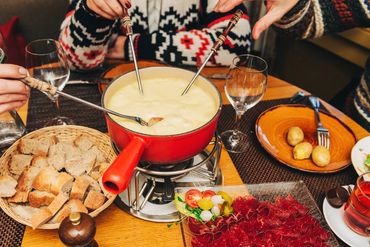
Time to create a stir: fondue is a symbol of conviviality and Swiss cuisine. Its main ingredient: cheese. But also some intellectual property (IP). Because cheese specialities can be protected by indications of source such as ‘AOP’ and ‘PGI’. In cheese fondue, farming law meets intellectual property law.
Not every cheese that ends up in the fondue pot has a protected indication of source. But some famous ones do. Twelve Swiss cheese specialities currently bear a protected appellation of origin, including Gruyère AOP, Emmentaler AOP, Sbrinz AOP, Vacherin Mont-d’Or AOP and Formaggio d’alpe ticinese AOP (you can find a complete list at the bottom of this page).
PAOs in a nutshell
Protected appellations of origin (PAO or PDO, often better known by the French abbreviation AOP – appellation d’origine protégée) are specially protected indications of source that are entered in a register maintained by the Federal Office for Agriculture (de, fr, it). They protect products from a precisely defined geographical area that are produced according to traditional local methods and that owe their quality or typical characteristics predominantly or exclusively to the geographical conditions in their place of origin.
Producers who wish to use the designation of source must comply with the origin, process and quality requirements set out in the relevant product specification. These are comprehensive and detailed – and by all means of interest to cheese lovers too.

“Holes are desirable, but not essential”
Let’s take a look at one example – the product specification for Gruyère AOP. This hard cheese is a popular ingredient in fondue mixtures. At the 2025 Fondue World Championships in Tartegnin, all mixtures had to contain at least 50% Gruyère AOP. A Gruyère AOP cheese was also awarded first place in the 2025 World Cheese Awards.
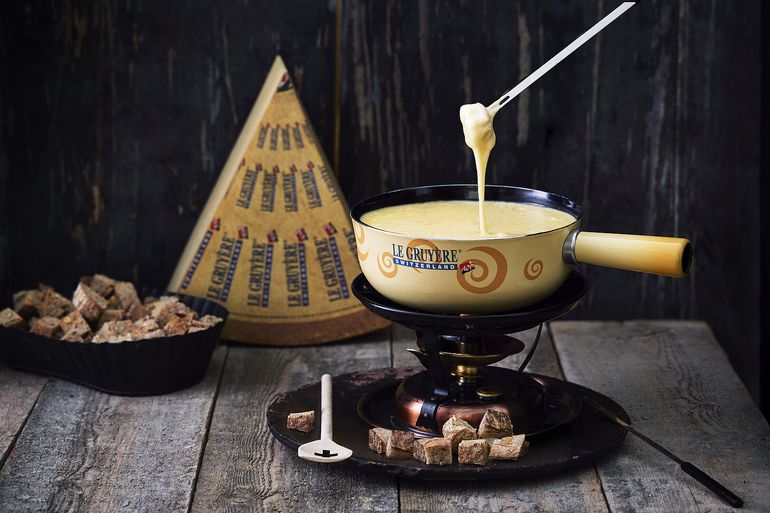
According to the product specification, the origin of this hard cheese is restricted to the cantons of Fribourg, Vaud, Neuchâtel and Jura, and to certain municipalities in the canton of Bern. The ‘physical and organoleptic characteristics’ of Gruyère AOP include the fact that it’s ‘a round wheel with a smear-ripened, grainy, uniformly brownish and healthy rind’: It must be 9.5 to 12 cm in height and weigh 25 to 40kg. Holes are apparently desirable, but not essential.
In terms of taste, the specification states that ‘the more or less salty base note is dominated by fruity flavours resulting from the interaction between lactic acid fermentation and smear’ but ‘the taste can vary depending on the terroir’.
Moreover, the fat, water and salt content are precisely regulated in the specification, as are the exact foodstuffs that the dairy cattle are allowed to be given. Growth promoters, hormones and similar products are prohibited. We also read that the milk is processed in open copper vats with a maximum capacity of 6,600 litres and that the cheese wheels are placed on raw, unplaned spruce wood (Picea abies) racks in a cool cellar at 12 to 18°C to mature.

PAO – guaranteed no foul play
Compliance with the specifications is monitored by independent certification bodies. As a reward for their efforts, producers benefit from a strong quality label and the associated competitive advantages. Consumers, for their part, receive a guarantee of food quality and safety.
If all of this makes you hungry for more, you can find further information on protected appellations of origin and the specifications for all 12 AOP cheeses on the website of the Federal Office for Agriculture (de, fr, it).