For IP professionals
This is the portal for professionals working in the field of intellectual property. Here you'll find direct access to all necessary resources.
Quick links
Anniversary of the IPI: 30 years of trade marks in figures
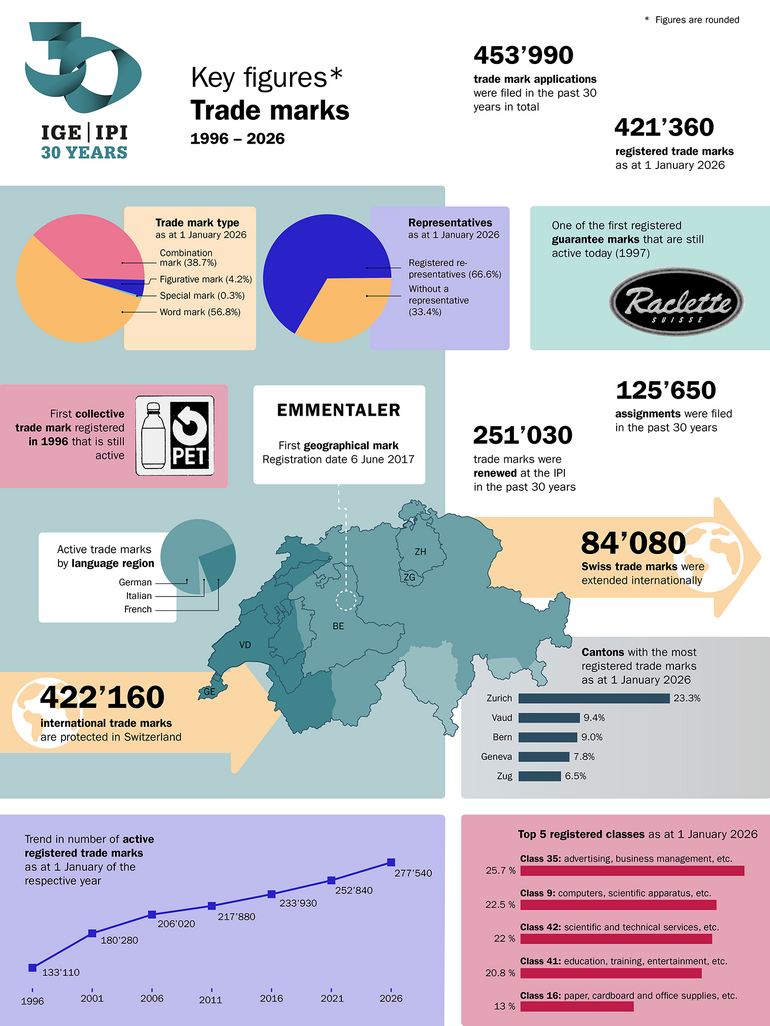
A look back over the last 30 years shows one thing above all: the number of trade mark registrations has risen steadily. From 1 January 1996 to 1 January 2026, around 453,990 trade mark applications were filed with the IPI. As of 1 January 2026, a total of around 421,360 trade marks were registered in the Swiss trade mark database. Trade mark protection lasts for ten years and can then be renewed. During the past 30 years, around 251,030 renewals were processed.

Type of trade mark and category of trade mark
The breakdown by trade mark type is clear. Word marks are the main type, accounting for around 57% of all trade marks, followed by combined marks (word/figurative) at just under 40%. Purely figurative and special types of trade marks (e.g. three-dimensional, position and sound marks) are rare. The breakdown by trade mark category is even clearer : around 99.5% are individual trade marks. Companies identify their products and services with an individual mark (e.g. SWISSCOM). Other categories of trade marks include collective marks, guarantee marks and geographical marks. A collective mark represents the goods or services of an association of manufacturing, trading or service companies. Only associations can file a collective mark – not individuals.
The first collective mark to be registered in 1996 that is still active today is PET (fig.), trade mark no. CH 422 173. A guarantee mark provides a guarantee that goods and services possess specific characteristics (for example regarding quality or geographical origin). One of the first guarantee marks to be registered that is still active today is Raclette SUISSE (fig.), trade mark no. CH 437 069. A geographical mark identifies products whose quality or reputation is significantly determined by their origin, and it protects the designation of that specific region. The geographical mark system depends on the existence of a prior registration, a foreign (controlled) appellation of origin recognised by Switzerland, a geographical indication, a Federal Council ordinance on the subject or an equivalent foreign regulation. The designation ‘EMMENTALER’ for cheese with the protected appellation of origin ‘Emmentaler’ was the first geographical mark to be registered by the IPI (trade mark no. CH 703 183, dated 2017).
Representatives
In the past 30 years, a representative was entered for around two thirds of registered trade marks. This means that all correspondence in the proceedings is handled by a trade mark consultant, such as a law firm that assists the trade mark owner with their trade mark strategy. However, it’s not mandatory to use a representative when applying for or registering a trade mark.
Geography
Switzerland’s multilingualism is also reflected in the languages used in trade mark proceedings: on average, around three-quarters of proceedings are conducted in German, followed by French and, to a much lesser extent, Italian. This is also evident from the breakdown of trade mark applications by language region.
Most applications come from economically strong cantons – led by Zurich, followed by Vaud, Geneva, Bern and Zug.
There were more than 125,650 assignments in the past 30 years, which shows that trade marks aren’t static. Instead, they are traded, assigned and managed strategically.
National and international trade mark protection
Trade marks are generally only protected in the countries in which they are registered. A trade mark will be protected in Switzerland if registration is applied for at the IPI and finalised following an examination to determine whether there are any grounds for refusal. Once it’s registered, the protection can be extended to numerous other countries through an international procedure. In the past 30 years, over 84,000 Swiss trade marks were registered internationally in this way. Conversely, protection for trade marks registered abroad can also be extended to Switzerland. In the past 30 years, applications were filed to extend protection to Switzerland for over 422,000 international trade marks. The World Intellectual Property Organization (WIPO) in Geneva is responsible for registering and administering international trade marks.
Classes of goods and services
Trade marks aren’t abstract: they’re only protected for specific goods and services, The International Classification of Goods and Services established by the Nice Agreement (known as the Nice Classification) groups all goods and services into a total of 45 classes. The class of goods and services most frequently registered over the past 30 years is Class 35 (advertising, business management, administration).
The figures for the past 30 years show that trade marks play a central role in economic activity over time. Not only are they registered, but they’re also renewed, assigned and extended internationally. At the same time, the data highlights the steady, consistent use of the trade mark system in Switzerland.