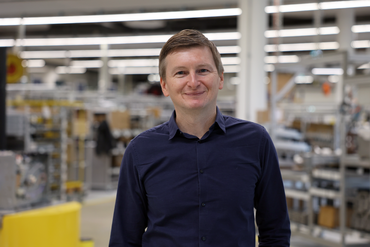
R. Nussbaum Ltd manufactures fittings and piping systems for industrial and commercial use, among other things. It files several patents based on strategic considerations every year. In its preparatory work for patent applications, it draws on artificial intelligence, taking great care with the data it uses. The Head of Research Patrik Zeiter warns against rushing into patent applications with the help of AI. - Part 2 of our series: How Swiss companies use AI to drive innovation and how it affects patent applications.
AI has been in use in the Research Department at R. Nussbaum for two years now. The tools assist researchers in developing new technical solutions and conducting the necessary searches. They also tap into AI for help with brainstorming. “In dialogue with AI, we can refine and further develop the solutions we’ve devised,” says Zeiter. They then discuss the results of this dialogue with their colleagues.
The company’s development of a frost-proof garden valve shows how it uses AI in practice. To begin with, the developers considered whether the new design was suitable for use on a construction site. Numerous site visits would normally have been necessary to find this out. However, AI enabled them to answer this question on a computer with the relevant parameters, design plans and ideas. Patrik Zeiter and his team then wanted to know how the new solution would work with a concrete or timber structure. And what they could optimise. “AI provided us with valuable insights and broadened the range of options. Some of those ideas might not have occurred to us otherwise. So we see AI as a useful partnership between humans and machines. But in the end, we humans are the ones who decide what’s to be done,” says Zeiter. And despite all the virtualisation, they still have a 3D-printed prototype sitting on the table when they’re developing a new product. “The garden valve is one of the first outcomes of the successful ‘collaboration’ between artificial and human intelligence at R. Nussbaum,” concludes Zeiter.
Data security: trade secrets and AI
Data security is of paramount importance in R. Nussbaum’s collaboration with the service providers that supply its AI tools. The providers of these tools assure R. Nussbaum that the data is used solely for training purposes. “But we don’t want to rely on that assurance,” says Patrik Zeiter resolutely. Hence, R. Nussbaum weighs up very carefully what information it will allow the AI to use. The more specific the content, the more cautious R. Nussbaum’s approach is. Zeiter believes that a healthy dose of scepticism is important. As a result, the staff responsible for never feed it with specific details of the manufacturing process or with data on materialisation. “This information could constitute a trade secret, and it would be disastrous to feed it into an AI tool,” emphasises the Head of Research.
Despite AI support, less is more for patent applications
As well as providing input, AI can also speed up the process for potential patent applications. A patent search can be completed more quickly using AI tools. Nevertheless, R. Nussbaum does not intend to file any more patent applications than before. “Our motto is ‘Less is more – and quality counts’. We don’t think it’s necessary to apply for a patent for every patentable solution. As an SME, we simply couldn’t afford to submit dozens of inventions every year, partly for financial reasons,” emphasises Patrik Zeiter. R. Nussbaum currently files three to four patent applications per year. For a company with 500 employees, that’s no small matter, according to Zeiter. He adds: “This volume still makes economic sense for us. The trick lies in searching for meaningful innovations across the entire spectrum to find out whether there’s a risk of a freerider copying exactly what we’re doing.”
Insight into R. Nussbaum’s IP strategy
Patrik Zeiter also offers an insight into his company’s intellectual property (IP) strategy in connection with its use of AI. He comments that none of their projects involve rocket science: their product range consists of simple items such as pipes, connectors and fittings. “As they’re not very complex, the products are easier to copy,” he says. He adds that they apply for a patent once they’ve identified their new inventions. “It’s worth protecting them, as they’re very simple solutions and the risk of copycats is high.”
Whenever a new inventive idea arises during the planning of a new product, Patrik Zeiter carries out an initial patent search. Thanks to the use of artificial intelligence, such searches have become faster and much more efficient. “This allows me to see at an early stage whether our innovation might infringe third-party rights and whether the planned technical solution is sufficiently novel,” explains Zeiter.
AI for initial searches on the state of the art
Zeiter points out that this form of preliminary analysis would not have been possible a few years ago without AI. At that time, patent attorneys were often involved in the search process at an early stage. “Today, we use AI for internal, exploratory searches on the state of the art. If we see a lot of potential, we bring in the patent attorney at a later stage and in a targeted manner,” says Zeiter. The legal consultation is deliberately conducted on a secondary basis and without any request for an official examination. Instead, the aim is to contextualise findings, critically assess the scope of protection and gather additional expert views on how to proceed. Only if the outcome of this consultation is positive do they decide to file a patent application.
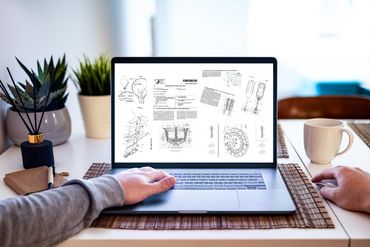
This makes the preliminary phase – that is, the patent search using AI – all the more important. “AI makes it possible to analyse thousands of state-of-the-art texts. Our approach is to feed some state-of-the-art patents into an AI model, which allows us to use the AI model as a chat partner. The model enables us to use this vast amount of documentation directly as the basis for our queries. That was previously inconceivable.”
Is there a risk of low-quality applications?
Patrik Zeiter fears that AI will open the floodgates for masses of low-quality patent applications. “Companies that were previously unable or unwilling to pay for a patent attorney can file patent applications relatively cheaply using AI.” Whether such patents will be granted or whether they are legally valid is another matter. However, such ‘junk’ applications could change the rules of the game when it comes to legal certainty. “For us, patent protection also means that we can operate with confidence in the market and avoid conflicts with third parties,” says Patrik Zeiter. If huge numbers of applications are now published, this could pose a greater threat to novelty. It will be more difficult for R. Nussbaum to find a niche for inventions it devises that meet the criteria of novelty and inventive step.