“AI is an extra tool. Our solutions still come from people”
V-ZUG uses AI as an additional tool in its innovation process. But the technology also has an indirect influence on the way V-ZUG inventions are filed, says Christian Roth, Head of Innovation and Technology at the Zug-based company.
Christian Roth, Head of Innovation and Technology at V-Zug. Photo: IGE
AI tools are used in a variety of ways at V-ZUG. “They make working in Office applications easier, but they’re also very useful for coding in software development,” says Christian Roth. “We’re also increasingly trying to incorporate AI applications into our products. But only if they offer a direct benefit to our customers,” he adds. Integrating modern technology into products is also in line with the company’s vision of bringing a sense of ease into the home and creativity into the kitchen.
Innovation process
In addition to its general use within the company, artificial intelligence also brings greater efficiency to the development process, according to Roth. He explains: “AI makes global knowledge more accessible, allowing us to search databases more quickly and bring our products to market faster.” However, there are also some limitations. In his experience, AI simplifies day-to-day tasks in the innovation process, but the technology doesn’t yet play a creative role.
Roth cites the dishwasher as an example: “Twenty years ago, every dishwasher had an upper and lower basket. If you’d asked AI what to do in future, it would have come up with various suggestions for upper and lower basket options. The software wouldn’t have come up with the idea of a cutlery drawer as we know it today,” says Roth with conviction. There’s a risk with AI that the mainstream will become even more entrenched in innovations: “Commonly used solutions appear even more frequently because an AI tool always focuses on what already exists. We should never blindly rely on AI suggestions, as that makes us neglect our own ability to think up solutions.”
Protection
V-ZUG invests a great deal of money and resources in new products and features. So protecting such innovations is also part of the company’s strategy. “We consistently protect our inventions with patents in order to gain a competitive advantage. Patent applications mainly cover user concepts and technical solutions,” says Roth. He adds that trade marks are also a valuable component of the protection strategy.
Filing patents
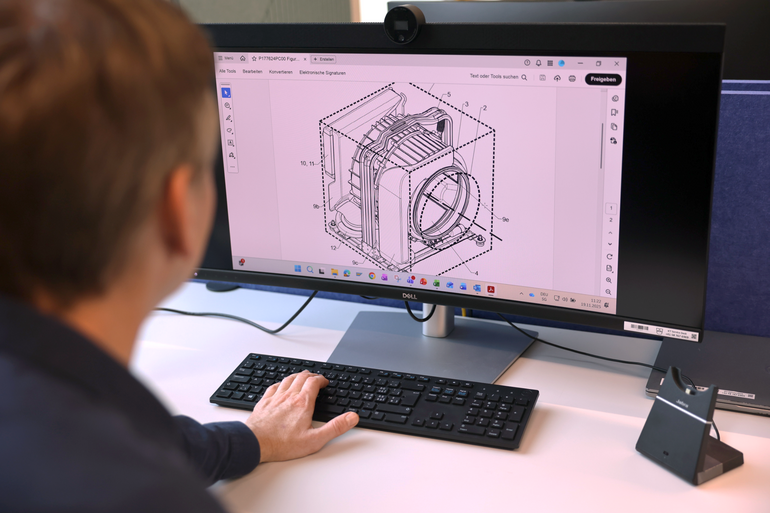
Despite the use of AI, the process of filing patents hasn’t changed significantly so far. “We’ve become faster at conducting patent searches. So we can assess more quickly whether we need an invention or whether we have the very solution that another company has already patented. We use appropriate tools,” says Roth. But he points out that the increased complexity of all modern appliances is likely to be more of a driving factor than the greater use of AI when it comes to registering new ideas.
Christian Roth always has the information from the company’s internal AI searches reviewed by a (patent) law firm. The patent attorney also carries out a thorough freedom-to-operate search to ensure that V-ZUG’s innovation doesn’t infringe the rights of third parties. According to Roth, the boundary between AI, machine learning and classical optimisation is blurred. “For example, certain kitchen appliances use processes that were found using AI-based optimisation. An AI service on our website helps clients look for appliances. Appliance errors are classified and assigned using AI, and so on.”
Nevertheless, V-Zug doesn’t print ‘AI inside’ or anything similar on the front panel of its appliances, as some of its competitors like to do. “It’s the function that counts for us – regardless of the underlying technology.”
V-ZUG makes targeted use of AI technology in household appliances and associated digital channels. “If we develop an AI feature, we don’t highlight it prominently on control panels or similar surfaces.” According to Roth, customers should experience the added value in their day-to-day use of V-ZUG’s devices or services and in the perfect result – if a pizza is really crispy or the laundry is really clean: “That’s what counts – not whether you can boast with an AI sticker.”
Roth explains that V-ZUG’s patent strategy is well aligned with the availability of AI systems. As a result, he doesn’t expect any ‘revolutionary changes’ in how it conducts searches, prepares applications and handles conflicts.
About V-ZUG
V-ZUG AG is a Swiss manufacturer of premium household appliances based in Zug. Founded in 1913 as Verzinkerei Zug, the company manufactures washing machines, tumble dryers, dishwashers, ovens, steamers and refrigerators in Zug and Sulgen. As the Swiss market leader with over 3.6 million appliances in use, V-ZUG focuses on sustainability, innovation and Swissness. The company’s been listed on the stock exchange since 2020 and has international subsidiaries. It employs 2,200 people worldwide, most of whom work in Switzerland.
Artificial intelligence also brings greater efficiency to the development process, according to Christian Roth. Photo: IPI
Christian Roth in conversation with patent attorney Joel Hochreutener (E. Blum & Co AG). Among other topics, they discuss AI-based searches. Photo: IPI
Conclusion
“At V-ZUG, we see AI systems as generally useful tools that can support us in our development process. It’s crucial for our innovation that we continue to understand our customers’ needs and match these with technically feasible solutions. We naturally aim to push the boundaries of technology in the process. That’s how we market ourselves.”
“Despite all the advantages of AI that I’ve mentioned, I also think it’s important that we take a critical look at this technology. The tools tend to be superficial, and you can easily find yourself in an illusory world. Our own thought processes sometimes suffer as a result. “That’s why I think we should use AI in a targeted way and not see it as a solution to all our problems,” says Roth.
Protecting Innovation in the Age of Artificial Intelligence
How are Swiss companies using artificial intelligence within the innovation process? Does its use influence their approach to patent filings or shape their overall intellectual property strategy? To explore these and related questions, the Swiss Federal Institute of Intellectual Property (IPI) conducted a series of interviews with decision-makers and innovation leaders across a range of companies.