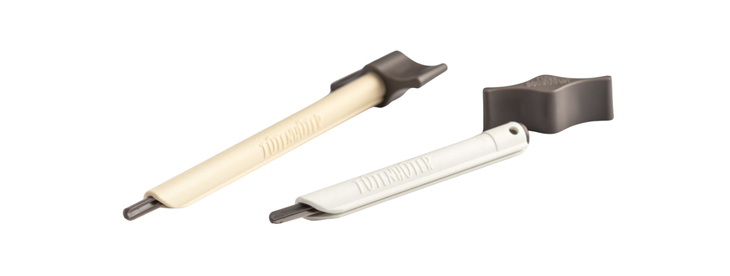
It all began in 2018 when Sandra Gschwend and Christian Diethelm set off as strangers on an adventurous trip to Thailand. They returned as a couple and future business partners. Their journey inspired the company name ‘böörds’ and their first product: a clever fastening system for food packaging. In the very same year, they registered the trade mark ‘Tütenhüter’ with the IPI. Seventeen months later, the start-up appeared on the TV programme for start-ups ‘Die Höhle der Löwen’ (the Swiss equivalent of Dragon’s Den). In 2020, it won an SBB award for innovative companies. Today, its Swiss-made products are available in over 450 specialist stores in Switzerland. They’re also sold throughout the EU via the company’s online shop.
For IP professionals
This is the portal for professionals working in the field of intellectual property. Here you'll find direct access to all necessary resources.
Quick links
"One investor criticised the German term"
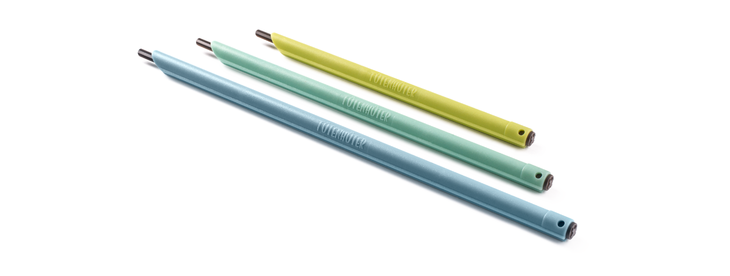
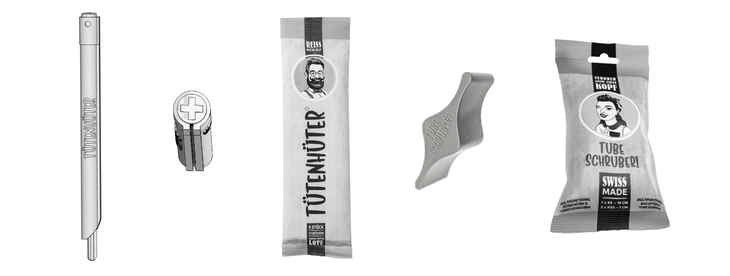
Founded in 2018, the company ‘böörds’ has become well known for its ‘Tütenhüter’, a Swiss-made sealing system for food packaging. In 2021, the ‘Tütenhüter’ was followed by a multi-functional tube screw (‘Tubeschruberi’) to squeeze out the last dregs from tubes. We talked to the company’s owner about the origins of its creative trade marks and her experience with using them.

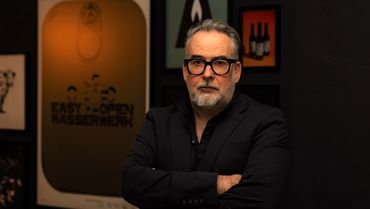
Sandra Gschwend, owner of böörds AG (© böörds AG)
Sandra, how did you come up with the trade mark ‘Tütenhüter’ for your first product?
When we returned from the trip that gave rise to our start-up, we did some brainstorming with friends. Someone jotted down ‘Tüten hüten’ (minding bags) on one of our countless post-it notes. We all liked it immediately. My then partner Christian and I wanted a noun, so we turned it into ‘Tütenhüter’ (bag minder). Finding a name was lots of fun overall.
What was important to you when choosing the name?
We had ideas in English too, but deliberately opted for a German name because we wanted to establish the brand in German-speaking countries in particular. When we appeared on the Swiss Dragon’s Den TV show, we were instantly criticised for using a German term. One investor said that this would limit us and that we could forget about English-speaking sales markets. He claimed that all terms with accents are extremely problematic. But our products also sell very well in French-speaking Switzerland, and we’ve been supplying the entire EU since 2025. So far, so good. Ultimately, the word formation is simply a trade mark and it doesn’t matter if you don’t understand it in English or French.
So you wouldn’t do anything differently today?
No. The term ‘Tütenhüter’ is very distinctive, and people like it. However, some people also imagine it to mean all sorts of weird things. In my opinion, this is exactly what makes a good trade mark. It’s not obvious or boring, so people investigate it and talk about it, including on social media. That definitely helped us too.
What branding strategy are you pursuing?
We’re using an umbrella branding strategy, with the company name ‘böörds’ as the umbrella brand. From the start, we considered it important to push the umbrella brand as well as the product brand so that it would become well known and we could use it to launch further products later.
How did the company name ‘böörds’ come about?
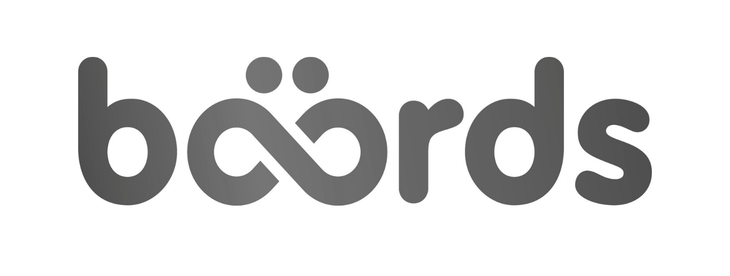
‘böörds’ is the German transliteration of the English word ‘birds’. We came up with the idea during our trip to Thailand. Travelling about in a minibus, we listened to lots of Swiss German songs, such as ‘Uf u dervo’ by Gölä and ‘E Vogel ohni Flügel’ by Peter Reber. These songs feature a bird that stands for freedom and independence. That’s exactly what we wanted with our own independent business. The two ‘ö’s represent Christian and me, the two founders.
Can you describe the creative process involved in turning the word into a graphic design?
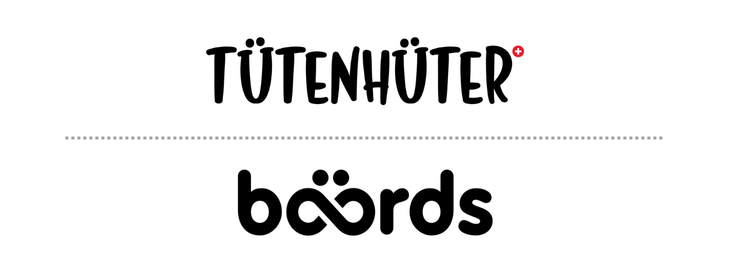
We initially commissioned a graphic designer to create a logo for the word mark ‘Tütenhüter’. As Christian and I are both cheerful, we wanted the ‘Ü’s to be designed as smileys. However, the graphic designer then suggested that we depict ourselves, so the dots on the ‘Ü’ now symbolise our heads facing each other.
We then decided to apply this idea of depicting ourselves in the lettering to the umbrella trade mark. So for ‘böörds’ we came up with a double ‘ö’ in the form of an infinity sign, in which Christian and I are sitting opposite each other.
How did the figurative marks that you use together with the word marks ‘Tütenhüter’ and ‘Tubeschruberi’ come about?
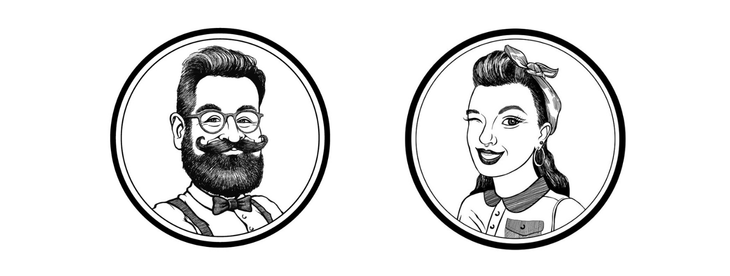
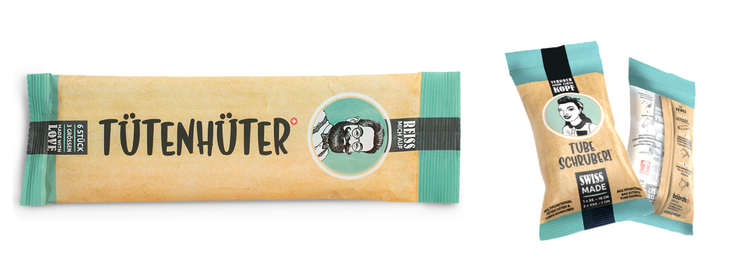
Visual language is very important for our brand identity. When we created the term ‘Tütenhüter’, we immediately saw our bag minder as a person: a dapper gentleman with a handlebar moustache who likes to avoid food waste and therefore wants to seal his bags properly. That same evening, we created a brief for a caricaturist who lovingly drew the gentleman by hand. Around three years later, he was joined by his partner ‘Tubeschruberi’. Our aim in using these figures was to tell a story and give our products a heart and soul. Producing goods in Switzerland is expensive. That means they need to have an appealing, high-quality appearance, so that they’re also suitable as gifts.
Why did you opt for trade mark protection?
Christian and I both previously worked in product development. It therefore went without saying that we would register our trade marks as soon as they were created. We’ve always protected all trade marks as broadly as possible as a domain too. In addition to boeoerds.ch, böörds.ch and tütenhüter.ch, for example, we’ve also registered all the terms as .de, .at and .com domains. All addresses are redirected to www.böörds.ch.
Did you carry out a trade mark search or clarify the potential for conflict before filing the application?
Yes, we really searched through everything and checked whether something similar already existed.
Have there been any conflicts with similar trade marks or products to date?
There have been similar products. One has disappeared from the market, and the other doesn’t seem to be very successful. We’ve been successful with ‘Swiss Made’ and we’ve established strong brands, so it’s not easy for others to catch up with us.
What advice would you give to company founders?
As ‘böörds’ was a new, invented term, we didn’t need Google Ads in the first few years. We were so unique that we were always listed at the top of the search results. Of course, that means that people need to know the search term. However, my advice to everyone would be to choose a term that doesn’t exist yet.
Thank you very much for talking to us, Sandra!