Artificial intelligence (AI) is fundamentally transforming pharmaceutical research. It plays a key role at companies such as F. Hoffmann-La Roche Ltd. “AI helps us during the research stage, but also afterwards,” explains Andreas Poredda, the Chief Patent Officer at Roche.
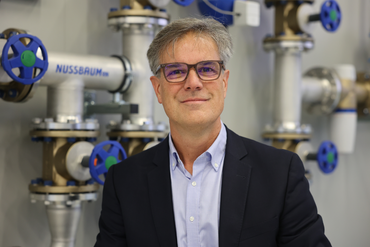
Andreas Poredda, Chief Patent Officer at Roche. Photo: IPI
AI saves Roche employees a significant amount of time during their analysis of scientific publications at the start of the research process. It sifts through vast amounts of data and filters out relevant information faster than ever before. In the laboratory, it carries out thousands of experiments autonomously. However, people remain the key factor. “Humans supervise the AI, select the experiments and evaluate the results,” emphasises Poredda.
AI speeds some things up – but not everything
AI can also make the planning of clinical trials much more efficient. Researchers can draw specifically on data from previous studies and thus optimise the study design. Yet AI can’t speed everything up, as there are natural limits on some kinds of research. For example, it isn’t possible to shorten the time it takes for certain slowly progressing conditions, such as Alzheimer’s, to develop. “AI is of no help here, because the timeline is determined by biology,” says Poredda.
In such cases, AI comes in more useful in the analysis of studies and compilation of comprehensive files for the regulatory authorities. As well as its assistance in data analysis, Poredda values another quality of AI: “It can identify new connections and provide further points of reference. In that sense, it is even creative in a way.” However, AI is not recognised as an inventor as defined in patent law.
Maximum data security and humans in the loop
Roche supplies its employees with a wide range of internally approved tools and prohibits the use of any tools for which data security cannot be guaranteed. Within this framework, Roche takes a pragmatic approach: employees can use whichever approved tool works best for the task in question, provided that all data is protected and regulations are strictly adhered to. “Patient data requires special protection,” emphasises Poredda. Whether a tool has been developed in-house or by a third party, it must not use the information entered to train external cloud models.
Despite the efficiency gains brought about by digital tools, human oversight remains paramount (the human in the loop). AI still tends to produce hallucinations – information that is entirely fabricated. This means that every result and every document must be checked by experts.
Danger posed by prophetic patents and patent scraping
AI has no fundamental influence on the group’s patent strategy. The nature of the inventions in question – molecules, processes and diagnostic solutions – remains the same. In addition to patents, Roche continues to rely on trade secrets, for example in relation to manufacturing processes, and on trade mark protection.
By contrast, AI has revolutionised the drafting of patent applications. It helps Roche employees to check texts, enhance them with additional information, check their consistency and produce initial drafts in record time. Nevertheless, the group’s patent attorney always remains in charge of the proceedings.
Roche also adheres to a clear code of ethics. It doesn’t patent purely theoretical ideas or thought experiments. It only submits patent applications for inventions whose functionality has been proven or is at least plausible. This means that, at the time of filing, staff must have held the invention in their hands and know for a fact that it works.
However, Poredda sees a worrying trend in the industry. Patent searches are increasingly finding prophetic patents. These are patents for innovations that have no experimental basis whatsoever and that have been developed by generative processes alone. He takes an even more critical view of what is known as patent scraping (or patent hacking). In this process, AI specifically analyses existing patent applications for gaps, with a view to using this information to file a large number of new, untested patent applications. This raises pressing questions, according to Poredda. What is legally valid? And how can patent offices provide legal certainty quickly enough in future?
Despite the efficiency gains offered by digital tools, human oversight remains paramount (‘human in the loop’). Photo: IPI
KI-Tipps von Roche für Unternehmen
Datenschutz als Befreiungsschlag: Die wichtigste Voraussetzung für den KI-Einsatz ist die Garantie, dass interne Daten das Unternehmensnetzwerk nicht verlassen. Ist dieser Rahmen gesteckt, nimmt das den Mitarbeitenden die Angst und schafft Raum für eine breite Nutzung (unter Ausschluss personenbezogener Daten). Heute nutzen bereits drei von vier Mitarbeitenden KI-Tools täglich.
Experimentierfreude fördern: Die KI-Tools sind bei Roche sehr beliebt. Das Ausprobieren und der gegenseitige Austausch schaffen eine positive Dynamik zum Verfassen der besten Prompts.



/hqdefault.jpg)