Robert Mirko Stutz is a lawyer specialised in design protection. It’s a topic close to his heart – he paints, designs, and creates Japanese-style flower arrangements (Ikebana), and a few years ago, he launched a fashion show. In this interview, he talks about the role of design, protection for designs and the major impact AI is having on the field.
“AI-based searches open up new possibilities in regard to design protection,” says design protection expert Robert Mirko Stutz. Photo: IGE
Robert Mirko Stutz has always been fascinated by form and design, as well as drawing and painting. He even taught himself to sew and later to develop his own patterns. Robert then put this in-depth knowledge to use by setting up a fashion show. “At some point, I had to decide whether I wanted to be a fashion designer or a lawyer,” says Robert Stutz in conversation with the IPI. In the end, he chose the legal profession and moved to London, where he pursued his interest in intellectual property (IP) law. Design protection is his area of expertise (see the infobox below).
What does design mean to you?
The legal definition of design is very simple: the creation of products – their form or surface. That’s it. Humans are extremely visual creatures – our brains process visual stimuli faster than linguistic content. It’s scientifically proven. So a product’s appearance is much more likely to influence your decision to buy it than its name. However, if you look at design as a cultural and societal phenomenon, it’s much more than just a product.
For example?
Design captivates and moves people, both literally and figuratively, and it’s an expression of the culture we live in. Design creates value, which means that it’s also an economic driver and a tool for tackling societal challenges, such as sustainability, inclusion, health and the responsible use of resources.
How can I protect a design?
In most countries, you can protect designs simply by registering them, whether you file a national application with the IPI in Switzerland or an international one with WIPO in Geneva. Only the visually perceptible form of the product is protected. The images that you include in your application are extremely important. The protection applies to what you file and provide visual evidence of, not to the product that ends up on the shop shelves. As the Designs Act only protects the design of products, the following are excluded from design protection:
Projections, fireworks, performances, events
Choreography and musical works
Services
Communication as such
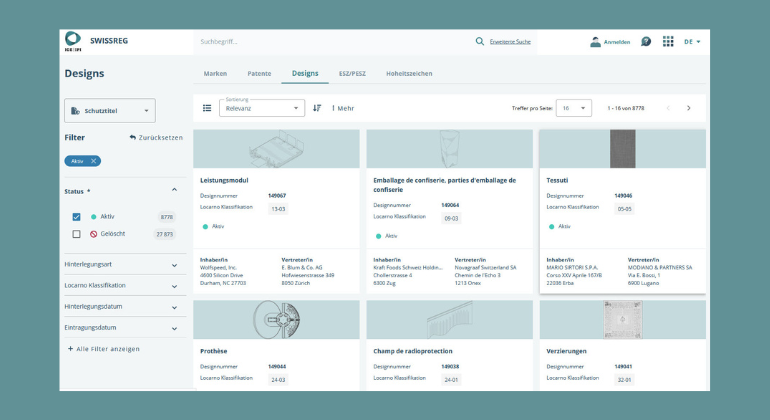
Robert knows from his experience as a lawyer that it’s very difficult to defend your design without a registered IP right. The image shows the design section of the Swiss IP rights register, Swissreg.
Intellectual property rights aren’t free. When is it worth filing an application?
That depends on the potential of the design and the business model. If you want to sell long-lasting products and make a living from them, you need to protect the design and, most importantly, defend it. Otherwise, when you market the product, you risk being copied if the investment can’t be defended. And it’s difficult to do so without a registered IP right. Design protection is documented in an official register so it’s easy to prove.
Why is that?
If you haven’t protected your design, third parties will be much more tempted to copy it. We’ve seen that in practice. In the case of possible infringement, issuing a warning to the infringer is often enough to put a stop to the plagiarism. And when you register the design, you get an official document from the authority confirming that you own it.
As with all IP, you have to consider the international component. An IP right is only protected in the country in which it was registered. So a design right in Switzerland isn’t very helpful if infringers decide to wreak havoc in a different country. In this case, international protection via the Hague Agreement is helpful. Under this agreement, you can protect a design in several countries with just one application. Alternatively, you can use a national filing as a basis to extend protection to additional countries and claim priority based on the first filing. If you’re operating successfully on an international scale, you have little choice but to enforce your rights. Otherwise, you’ll quickly lose your foothold – copycats are quick, brazen and business-savvy. Without a registered IP right, it’s very hard to defend your design.
When most people hear ‘design protection’, they probably think of furniture, watches or everyday items. How does design protection work for software, app user interfaces and AI?
Software itself can’t be protected under design law. However, it’s possible to protect graphical user interfaces (GUIs) or parts of them under the Designs Act because they’re designed products. This form of protection is popular. On average, more than 1,000 user interfaces are filed as designs with WIPO each year. By the way, these belong to Class 14 of the Locarno Classification (recording, telecommunication or data processing equipment). This class of design protection is actually the second-largest group of registered designs worldwide, following closely behind means of transport (accounting for 12%).
“Design creates value, which means that it’s also an economic driver,” says Robert Mirko Stutz. Studies by McKinsey show that products that are more functional and aesthetically pleasing generate higher sales. Photo: iStock
Novelty is a requirement for design protection. How realistic is this requirement in the age of AI and social media? Millions of designs are being circulated around the world.
Novelty simply means that, for a design to be eligible for protection, there can’t be an almost identical design in existence. That’s still possible nowadays. However, it’s a bit more difficult to fulfil the second requirement for protection: individual character. This is fulfilled if the overall impression of the design differs, for an informed user, from that of a previously disclosed (published) design. It therefore has to create a distinct overall visual impression. The designer’s degree of creative freedom is taken into account, and the threshold is higher than for novelty. It is indeed the case that as the number of designs increases, so does the likelihood that something similar has already been shown somewhere, meaning that a design may fail to meet this requirement. When assessing individual character, the focus lies primarily on which characteristics create the overall impression, namely silhouette, proportions and striking materials and patterns.
Applicants have to check the novelty of their design themselves to avoid infringing third-party rights. For trade marks and patents, it’s easy to find out by searching terms in databases. How can you search for designs?
That was indeed a major challenge for a long time. You had to search manually, which took several days because you had to dig through databases for existing registrations. You couldn’t use images to search – only product classes (for example the Locarno Classification). If I wanted to know whether my chair already existed in a similar form, I would have to search for chairs that had already been registered. Nowadays, AI tools can massively simplify the search.
How exactly does AI help?
You upload an image of an object in a design protection database, and the software will find similar objects. It’s similar to facial recognition. It’s quick and inexpensive, but you only get hits from design databases and not the internet. However, it’s sufficient for checking if your design infringes third-party rights. In the past, similarity searches took several days and were expensive, particularly global searches. Now that it’s easier, contracted designers in particular can no longer say that they can’t do a search because it involves too much time and money.
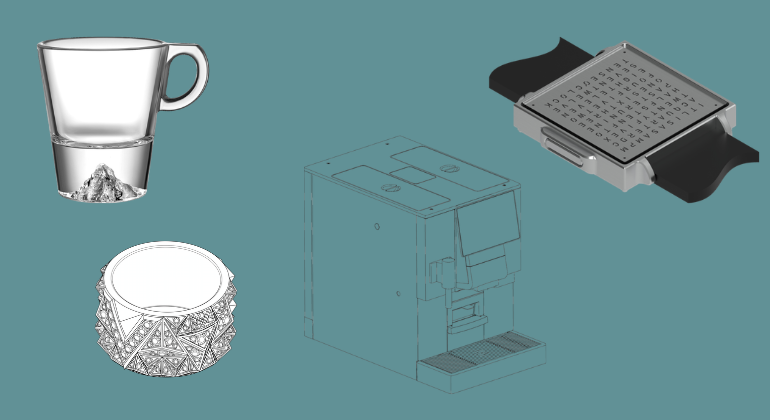
When you file a design, you also have to submit images of the object (see picture). Important: what’s shown in the images is what’s protected so it’s recommended to submit several images. Picture: examples of images filed with the IPI.
In the future, could I ask AI to create design proposals that don’t infringe existing registrations?
That will be possible sooner or later. The integration of AI as a whole is one of the most significant things to happen in design protection in the last five years. The previously mentioned AI search opens up new possibilities. But I don’t think that we’ll only have AI designs in the future.
Why is that?
No one wants to invest in a cultural asset that hasn’t been created by a human. Moreover, AI draws its inspiration from existing products, which were used to train it. So it’s not really capable of generating new ideas. It only ever produces variations from the existing data pool. That’s fine for creating a simple logo for a food stall or a local tradesperson. It’s unlikely to result in any major international successes.
Some designers think that protection isn’t worth it, partly because of the potentially costly enforcement and the time required.
It doesn’t take a lot of effort to register a design – to file with the IPI, you upload two or three images and pay a three-digit fee. It’s neither time-consuming nor expensive. Design protection makes less sense for fast-paced, trend-driven design industries, in which countless new creations emerge every year that no one cares about after a year or two. Too many designs would have to be protected, and the investment would be hard to recoup. Protection is worth it, however, for more long-lasting designs and is becoming more essential.
Having an entry in the design protection register is the first step. Then you need to enforce the design right by taking action against freeriders. What happens if person A claims that person B has copied their design?
If you make a claim, you have to back it up. The burden of proof in design law is no different than in any other civil case. If you’ve registered a design, it is presumed to be novel and have individual character and that you’re the authorised owner. Therefore, the warned party or defendant must prove that the design is invalid in order to avoid an adverse ruling. It’s also not about proving when the design was created – the date of the register entry is what counts. The rule in this case is ‘first come, first served’.
President of the Bern Design Stiftung (foundation)
Robert Mirko Stutz has a doctorate in the field of design protection, and he runs a law firm specialised in IP, which he co-founded with a work colleague. Robert has been teaching at several universities and colleges in Switzerland for years. He’s the President of the Bern Design Stiftung (foundation). He led the design team at MARQUES for many years and has produced a large number of publications, including co-authoring the Swiss Designs Act of 2001 and a commentary on the Hague Agreement for the protection of international designs, which will be published by a UK publisher in April 2026.
You can find out more about design protection on the IGE website.




![[Translate to English:]](/fileadmin/_processed_/2/6/csm_papiersammler_glaeser_portrait3_03d505f8a0.jpg "[Translate to English:]")