Daylight with privacy: how a Swiss engineer invented glass bricks
140 years ago, Gustave Falconnier from Vaud patented an idea that continues to fascinate people today: the glass brick. This building material has long been enjoying a revival as a design feature, after falling out of fashion for a while.
Detached house with glass bricks. Photo: iStock
Glass blocks are a feature of our everyday lives. We come across them in building façades, stairwells and floors. Their function is to flood rooms with natural light, while reliably protecting occupants’ privacy. The man behind this ever-popular building block is the architect Gustave Falconnier.
Before he came up with glass bricks, his work centred around a completely different issue: sterile glass containers. In the late 19th century, the design of baby bottles was a matter of life and death: tubes that were difficult to clean regularly led to serious infections. Falconnier worked on developing hygienic glass lids and had his first feeding bottle patented in France on 20 March 1873.
From baby bottles to glass bricks
While working on these hollow structures, he realised something significant: when hot glass is blown into rigid moulds, a cavity is formed. This insulates against the cold but also lets light through.
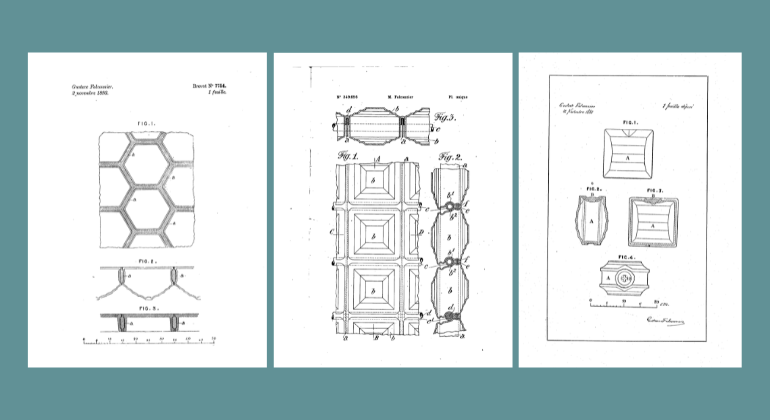
On 22 October 1886, Falconnier filed a patent application for his invention with the French Patent Office. He then extended this protection internationally: in 1888, he was granted a patent in Switzerland with specification CH48. Depending on the country, these certificates granted him an exclusive right of use for between 14 and 17 years (today, it’s usually 20 years).
Following his first patent, Gustave Falconnier filed several patent applications for improvements to his invention.
Production under licence
Once he had intellectual property rights for his invention, Falconnier meticulously controlled their exploitation. He applied for subsequent patents for refined processes and granted licences to foreign glassworks. In this way, he expanded globally without having to build factories himself. His marketing approach was clever: he had his name and the relevant patent numbers engraved directly onto the glass.
Glass bricks made their mark at the 1900 Paris Exposition, where they attracted a lot of attention. Architects such as Le Corbusier and Pierre Jeanneret recognised the bricks’ potential. Years later, they made extensive use of glass blocks in their famous Immeuble Molitor (constructed in 1931–34) in Paris.
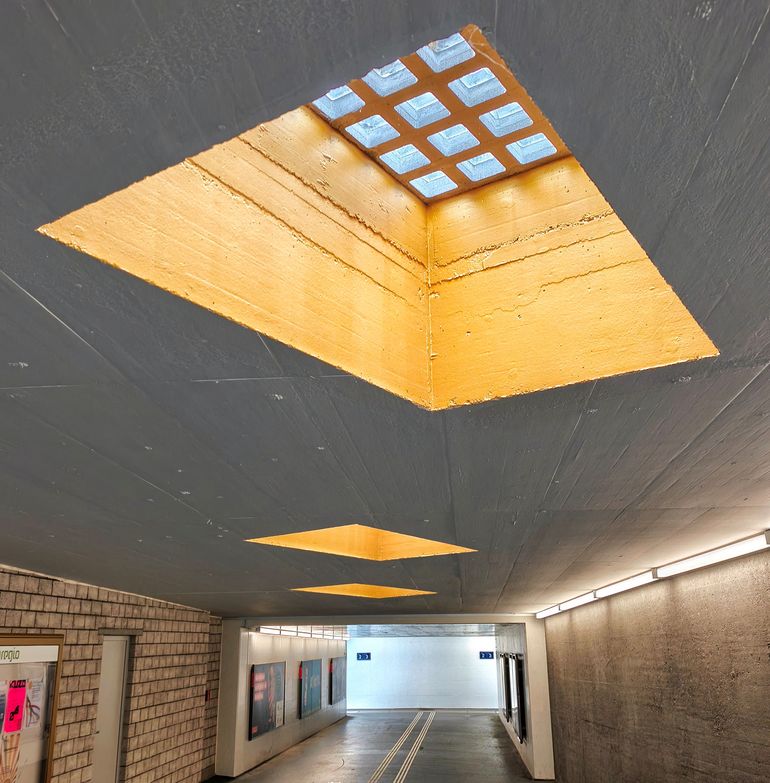
An eye-catcher: the pedestrian underpass at Zofingen railway station featuring glass brick elements. Photo: IPI
The basic principle has remained the same
The principle still holds true today, even though modern bricks have long been moulded industrially with two halves being pressed together rather than being hand-blown, as was the case in Falconnier’s days. New brick shapes have also been introduced. As well as the familiar rectangular prism, there are now round and triangular blocks, as well as matt or grooved surfaces and a wide range of colours.
The greatest accolade for an invention is its timelessness. Glass bricks have held their own from their early days in light shafts to their starring role in modern architecture. So Falconnier truly deserves this accolade.
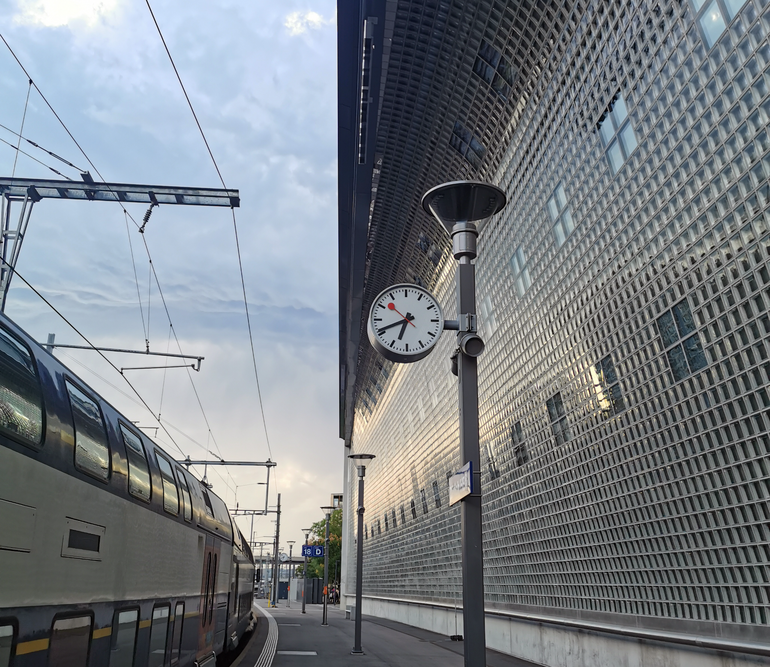
This building near Zurich's main railway station surprises with its enormous expanse of glass bricks. Photo: IPI