Zurich vitaparcours: fit for generations with trade mark protection
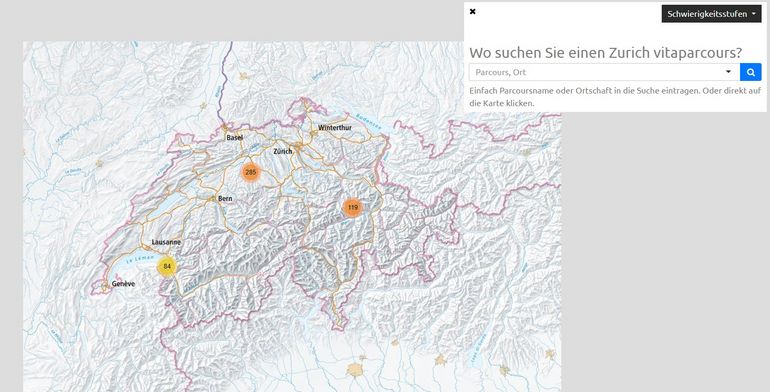
Want to burn calories and strengthen your muscles outdoors in Switzerland? Head off to one of the country’s many fitness trails in the woods. Trademarked as ‘Zurich vitaparcours’ routes, they’re a firm feature of the Swiss fitness landscape. Currently, there are 488 throughout the country. It’s not the concept of training in the woods that is protected by the trade mark, but primarily the name.
Der Froschhupf ist eine der Übungen, die einen heute auf dem Zurich Vita Parcours erwarten. Foto: Zurich Vitaparcours.
In the 1960s, Erwin Weckermann of Zurich-Wollishofen Men’s Sports Club began to move more and more of his club’s training sessions into the woods. He developed a permanent fitness trail with the support of forest ranger Carlo Oldani and university sports expert Charly Schneiter. The first vitaparcours was opened in Zurich in 1968. Following this first trail, Vita Life Insurance lent its support to the initiative and also gave it its name. The Zurich training route evolved into a nationwide offering. Today, the strategic management of the Zurich vitaparcours trails (as they have been known since 2008) is the responsibility of the VITA Parcours Foundation. All aspects of operational management are in the hands of the Zurich vitaparcours management team, a centre of expertise within RADIX Swiss health foundation.
Not just a few exercise stations in the woods
There is a consistent concept behind the 488 courses. “Zurich vitaparcours trails are more than just a collection of exercises. They’re based on guidelines that apply throughout Switzerland,” says Barbara Bächler, the head of Zurich vitaparcours management team. If you want to set up a new fitness trail, you need to contact the team. They will then visit the site to get a first-hand impression. A local provider – generally the municipal authority – is responsible for implementing and managing the trails. The Zurich vitaparcours team assists with the implementation work, provides materials and signposts, and officially approves the finished trail. Even after completion, standards remain important. Regular quality checks ensure that quality and safety standards are met.
How to protect a success story
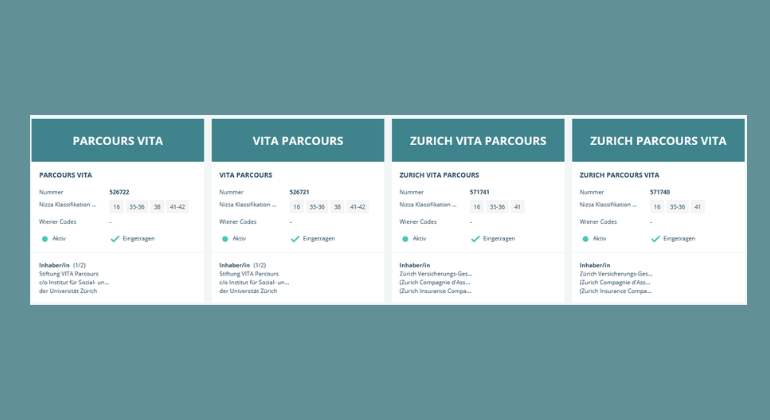
What exactly can be protected in a success story like this? The idea of offering various fitness exercises along a trail is worth protecting, but not with a patent. Patents protect technical inventions. A training concept as such does not count. In the case of the Zurich vitaparcours, the intellectual property value lies elsewhere – in the name itself. As the trails have grown in popularity, the importance of protecting the name has also increased. Hence, the foundation has registered several names as trade marks in the Swiss trade mark register: ‘Vitaparcours’, ‘Parcoursvita’, ‘Percorsovita’, ‘Zurich vitaparcours’, ‘Zurich parcoursvita’ and ‘Zurich percorsovita’. These cover the name in the different language regions of Switzerland.
A selection of registered trade marks in Switzerland.
Trade mark protection can be renewed as often as needed
Trade mark protection gives the holder the right, under certain conditions, to prevent others from using the same or similar signs in relation to the goods and services covered by the trade mark. This doesn’t protect the idea of keeping fit in the woods, but rather the name that the trails are known as. And trade marks have another advantage that fits in well with the Zurich vitaparcours: protection can be renewed as often as needed. By contrast, a patent can be protected for a maximum of 20 years. This means that a name can remain protected under trade mark law for generations. This protection is not just theoretical: time and again, Zurich vitaparcours has cause to assert it. “Many people don’t realise that ‘Zurich vitaparcours’ and ‘Vitaparcours’ are registered trade marks,” says Bächler. The term keeps cropping up in places that have nothing to do with the official vitaparcours trails. “We’ve even seen the name used for a canine agility course.” The team tries to resolve such cases through dialogue, which is usually sufficient. There have also been issues involving the design. For example, information boards have been copied, or elements of the official trail have been incorporated into initiatives run by other parties. “Anyone can run their own fitness trail, of course. If it doesn’t belong to us, it needs to be clearly distinct from the Zurich vitaparcours though,” says Bächler. Swiss citizens have for generations associated the word ‘vitaparcours’ with exercise and fitness in the outdoors. What began in 1968 as a fitness trail in the woods of Zurich has long since become a well-known brand. As a result, you know what to expect when you see ‘Zurich vitaparcours’ at the edge of the woods.
On the Zurich vitaparcours website, you can find an overview of all the routes in Switzerland
(copy 5)
The vitaparcours trail is no longer exactly as it was many years ago. The concept has been overhauled several times. Originally, there were 20 exercise stations with one exercise at each one. The current concept was developed in collaboration with the Swiss Federal Institute of Sport Magglingen based on the latest research findings. Over the years, the exercises have been revised time and again. Today, there are a total of 43 exercises to choose from across 15 stations. Yellow stands for mobility and agility, red for strength and blue for endurance. Ideally, a trail is a circuit of around two to two-and-a-half kilometres. And, of course, the landscape imposes its own limits: In Ticino, the subsoil, woodland and vegetation are different from those in the Swiss Mittelland in the north, for example. However, the basic concept remains the same everywhere.