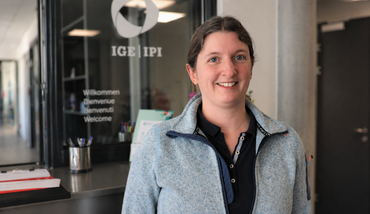
Anna McCann is one of the first candidates from Switzerland to take part in the EPO’s Candidate Support Programme, which is helping her to prepare for the European qualifying examination (EQE). The 30-year-old, who holds dual Irish-American citizenship, has been preparing for the EQE since 2025, and she sat the M1 and M2 exams in March 2026. Her experience with the CSP has had such a profound impact on her that she would like to work as a CSP coach herself one day.
For IP professionals
This is the portal for professionals working in the field of intellectual property. Here you'll find direct access to all necessary resources.
Quick links
From PhD student in Lausanne to trainee European patent attorney: Anna McCann on how she got into patent law
After completing a PhD at the Swiss Federal Institute of Technology Lausanne (EPFL), Anna McCann discovered the patent attorney profession in conversation. Shortly afterwards, she began her career in intellectual property at a law firm in Lausanne and started preparing for the European qualifying examination. She’s receiving support from the European Patent Office’s Candidate Support Programme (CSP).

Anna McCann, patent engineer at André Roland SA in Lausanne
Anna, you worked as an electrical engineer in Cork and then completed a PhD in cardiac research at EPFL. How did you make the move to intellectual property?
After finishing my PhD, I was faced with the question – what now? I gave it a lot of thought and was fortunate enough to have an in-depth discussion with André Roland, my current line manager, about intellectual property and the patent attorney profession. After that conversation and doing my own research, I knew that this career would be a very good fit for me. That’s how it all began, and I’ve been working as a patent engineer at André Roland SA in Lausanne since early 2024.
What are your responsibilities as a patent engineer?
I draft patent applications and liaise with the relevant authorities at every stage of the process. I also help to assess the patentability of inventions. Due to my technical background, I’m often entrusted with computer-implemented inventions, which need to be analysed in depth in order to identify patentable aspects.
Additionally, I carry out freedom-to-operate searches and monitor competitors’ patent activities.
Finally, I also advise clients on key strategic questions relating to protecting their innovations and defending their rights.
Why do you want to sit the European qualifying examination (EQE)?
Above all, because, in my opinion, the qualification lends me enormous credibility in the eyes of my clients. It also opens the door to a network of experts across Europe.
Besides that, I view the exam preparation as part of my training in the field of intellectual property. I’m deepening my knowledge of the European Patent Convention so that I’ll know how to proceed even in complex or rare cases. Acquiring this skill is important to me.
You’re participating in the EPO’s Candidate Support Programme (CSP). What does it involve?
It started in October 2025 with a kick-off meeting in Munich, which brought together all the participants from across Europe and their coaches. The meeting was an extremely motivating start to the programme. We were able to talk about so many things in a short space of time. I find it fascinating that, even though we work in different countries, we still feel closely connected through our shared work and the European Patent Convention.
Then there’s the coaching. My coach, a European patent attorney based in Turkey, mentored me and three other candidates. Almost every week, she sent us assignments on legal issues or practical exercises, marked our answers and gave us feedback.
Finally, we took part in distance-learning courses run by the Centre for International Intellectual Property Studies (CEIPI): a preparatory course for the M1 exam in October and one for the M2 exam in January. The courses were extremely intensive – several days packed with legal questions, mock exams and marking sessions.
What did you find particularly valuable?
All three elements – the kick-off in Munich, the coaching and the courses – were important. But the coaching was, of course, particularly valuable. It kept me accountable and gave me the opportunity to ask questions at any time. What’s more, our coach also provided us with moral and emotional support.
The experience has inspired me to mentor EQE candidates myself in the future. I really like the combination of professional discussion, personal support and an international network.
What would have been different without the CSP?
The exam preparation would have been considerably more difficult. I’m doing my internship under the supervision of a qualified patent attorney at our firm, of course. However, due to time constraints, he’s unable to provide the same level of support as my coach. I also believe that the CSP significantly improves my chances of success.
Did the M1 and M2 exams meet your expectations?
Yes, more or less. As expected, the exams were extremely challenging. You need months of intensive study to be able to answer the questions in sufficient detail.
Do you have any advice for future candidates?
First and foremost, I would team up with other candidates and find a mentor. I was in a WhatsApp group with three other candidates. When the WiseFlow exam software wasn’t working at 10pm on an exam weekend, I was able to quickly ask the group – and got immediate replies. That was very helpful. It’s these seemingly small things that ultimately make a big difference – both in terms of motivation and learning progress.
Finally, I would like to express my sincere thanks to the IPI, and in particular to Tanja Joerger, for the support I received during the CSP and on my journey to becoming a European patent attorney.
Anna has since found out that she passed the M1 and M2 exams. Congratulations! And thank you very much for speaking to us.