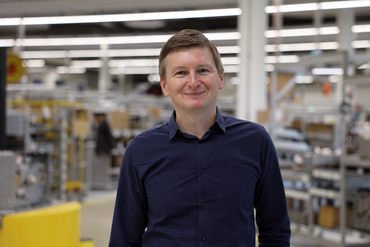
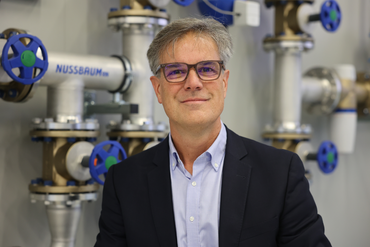
Since at least 2017, Salsberg has been speaking publicly about how AI systems are transforming innovation, and how intellectual property laws may or may not need to adapt. Not least thanks to ChatGPT, the topic is now on everyone’s lips. Salsberg is used to providing information on the subject. One message kept recurring throughout our discussion with him: AI, as used by Novartis in its innovation process, is the basis for entirely new tools for researchers – no more and no less. AI tools are available to them for their research work in the same way as more long-standing tools. Such tools require human input and, above all, the results need to be checked carefully. It’s clear to Salsberg that ideas still come from people – the inventors. So for Novartis, AI is an add-on to the innovation process and not a substitute for human researchers.
Generative AI also supports research
The second broad category of AI tools consists of generative AI used, for example, to help researchers design new molecules in silica. The basic concept is similar to how we use common AI tools today to generate new language or images, but with significantly more human direction and control. For example, as Salsberg explains, after an AI-enabled tool has been developed, trained and seeded with relevant datasets for a particular research task, a scientist might ask it to take attributes of a molecule or protein that have worked in the past and propose virtual versions of new molecules that also have those attributes or effects As with the use of non-generative AI, the main focus here is also on pattern recognition, but applying those patterns to something new instead of identifying them in an existing database. The output may consist of a large number of virtual molecules. The researchers then have to identify which, if any, molecules show promise and can be synthesized in the laboratory. Of course, from there, researchers also have to continue developing and testing those candidates, as basic molecules are only a starting point in the long and complex process of developing medicines. Here again, AI is providing significant value, but serves primarily as a tool to augment human ingenuity and to make research more efficient.
Novartis’ AI-enabled tools can be categorized into two broad types. Firstly, non-generative AI, which is primarily an analytical tool. Among other things, it identifies patterns in large amounts of data. And, thanks to its extensive research activities, the pharmaceutical company has a wealth of data. For example, in the form of digital libraries containing millions of potential active substances and corresponding combinations.
“If we know that a particular aspect of a molecule could potentially be useful in treating a disease, we can run AI in the relevant libraries to quickly find additional candidates that have that attribute,” says Salsberg. AI is also becoming invaluable in clinical trials, which are a compulsory part of the lengthy process of obtaining marketing authorisation for a medicinal product. In this context, AI makes it possible to identify suitable patients much more efficiently, particularly patients with rarer diseases.
According to Corey Salsberg, AI tools are now used as a matter of course in many aspects of Novartis’s innovation process. However, he adds that the array of AI tools offered by third parties can vary widely in quality, and that not all are fit for purpose for application in biopharmaceutical research and development. Selecting suitable, secure tools can be a time-consuming process. They need to meet Novartis’s practical, legal and ethical requirements and minimize the type of weaknesses that off-the-shelf AI tools in common use today often display.
Ruling out hallucinations
One undesirable side effect of generative AI systems is their ability to hallucinate. This applies in the pharmaceutical sector too. Sometimes, it’s only in the lab that it becomes clear that something isn’t quite right with the AI’s virtual protein or molecule. In addition, there are issues such as confidentiality and data protection, which Novartis addresses before deploying new AI tools. For all these reasons, its current focus when using AI is to boost efficiency. Remaining in the driver’s seat, directing the research, and quality assurance will remain the responsibility of the group’s employees for a long time to come. The example of Novartis shows that the use of AI in the pharmaceutical sector is no different from that in other industries.
Has the intellectual property strategy changed?
Corey Salsberg says that the use of AI as described has so far had minimal impact on Novartis’s intellectual property (IP) strategy. This is certainly true of Novartis’s traditional objective, which is to research and develop medicines to benefit patients. “Using AI doesn’t alter this mission, so it doesn’t alter the corresponding strategies either,” he emphasises. The only change is the introduction of new tools, which primarily affect work processes. Even though AI systems can generate far more compounds, it ultimately only makes sense to patent the most promising ones.
The special case of software-based inventions
It’s a different story when it comes to AI tools developed in-house. Although Novartis intends to remain a pharmaceutical company, it also develops software-based innovations where necessary and useful. Patents may play an important role here, as may trade secrets and copyrights. Novartis decides on a case-by-case basis what IP strategy to adopt, depending on the nature of the innovation and its intended use. “Our mission and core research activities are unlikely to change much over the next five years,” emphasises Salsberg, explaining again that Novartis is focused on developing and delivering medicines. “Although AI tools will enable us to make our processes even more efficient.”
Collaboration with regulatory authorities and patent offices
He sees significant potential for efficiency gains in the formal applications innovators must submit to the authorities for the authorisation of new medicines. AI-based tools are already available that analyse raw data from various clinical trials in line with the regulations of the relevant authorities. But there’s still room for improvement, according to the Novartis manager.
During the conversation, he also suggests that, at least for now, patent offices should focus their use of AI in the examination of patent applications on improving efficiency. “The quality of searches should remain the top priority,” he says. It should be clearly stated where and how AI is used in the examination process. Decisions should be transparent so that those responsible at Novartis and other innovators can respond accordingly.
Recommendations for AI beginners
AI doesn’t only offer advantages to large companies. Indeed, the opposite is true: smaller businesses in particular should benefit from it. “Be open-minded, but cautious!” Corey Salsberg advises. Contrary to what its name suggests, AI isn’t actually intelligent. At least for the time being, it won’t be taking over creative work or doing things on its own. “But used in the right place, it’s a powerful tool that can improve the existing innovation process and make it more efficient,” says Salsberg.